1. Raw Material Preparation
◦ Select high-carbon steel or alloy steel wire rods (e.g., 10B21, SCM435) that meet automotive fastener standards, and perform surface descaling (pickling or shot blasting) to remove oxide skin.
◦ Cut the wire rods into fixed-length blanks using a cutting die on the cold heading machine, ensuring the blank length tolerance is within ±0.1 mm.
2. Cold Heading Forming
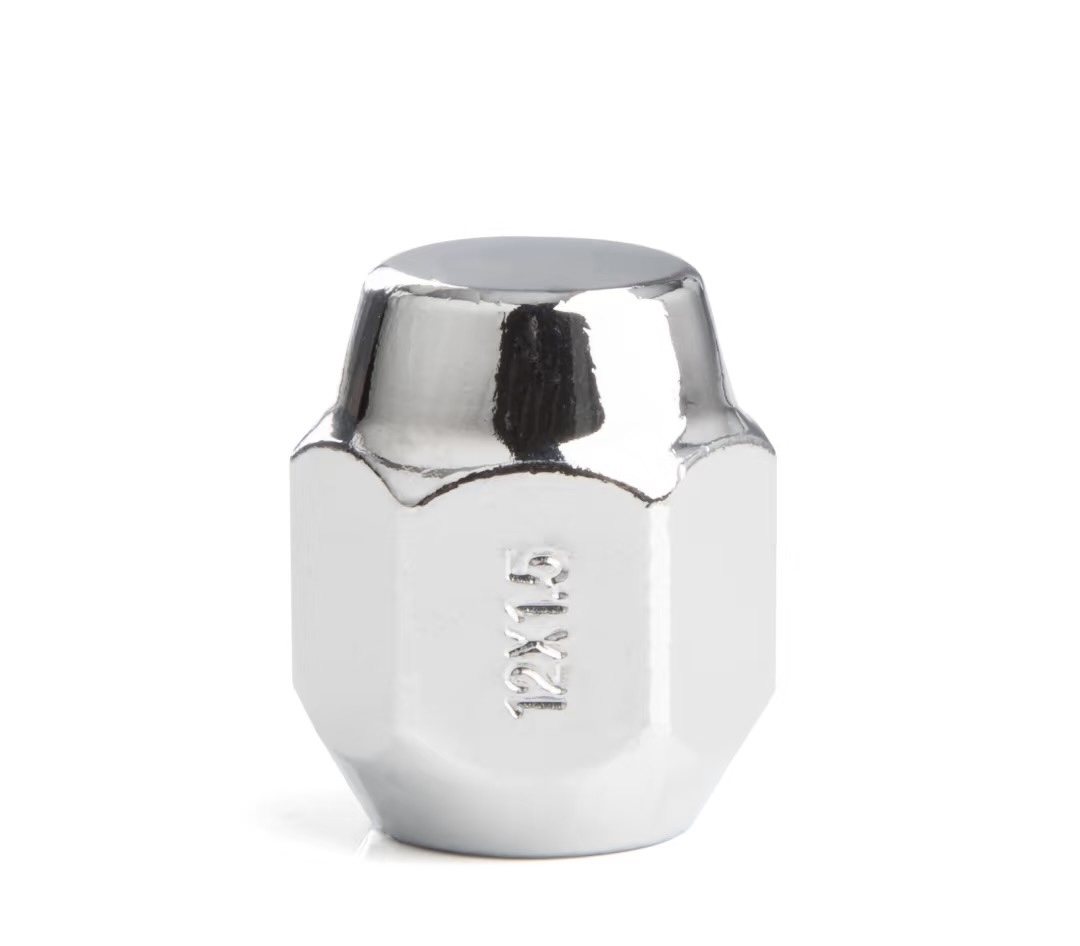
◦ Use a multi-station cold heading machine to perform progressive forging on the blanks at room temperature: the first station forms the nut’s bottom and shank, and subsequent stations shape the flange, taper seat, and drive hexagon (or special anti-theft shape).
◦ Control the forming pressure (usually 800–1200 MPa) to ensure the metal grain flow is continuous, improving the nut’s tensile and shear strength.
3. Thread Processing
◦ Adopt thread rolling (the mainstream method for wheel nuts) to form internal threads: press the blank against rotating thread rolling dies, and the plastic deformation of the metal forms precise threads with a tolerance grade of 6G/6H.
◦ For anti-theft nut sleeves, use CNC turning/milling to machine special-shaped inner holes (e.g., spline, hexalobular) that match the anti-theft nut drive end.
4. Heat Treatment
◦ Conduct quenching and tempering on the formed nuts: heat to 850–900 °C for quenching (oil or water cooling), then temper at 200–300 °C to achieve a hardness of HRC 28–32 (for regular nuts) or HRC 40–45 (for anti-theft nuts).
◦ For high-wear parts (e.g., anti-theft sleeves), perform carburizing/nitriding treatment to increase the surface hardness to HRC 58–62 and enhance wear resistance.
5. Surface Treatment
◦ Carry out electroplating (zinc plating or chrome plating) after heat treatment: first perform acid pickling to remove scale, then electroplate a 8–12 μm thick coating, and do passivation (yellow zinc or black zinc) to improve corrosion resistance.
◦ For high-end products, apply electrophoresis or powder coating to form a thicker protective layer (20–50 μm) for harsh working conditions.
6. Quality Inspection
◦ Check the thread accuracy with a thread gauge, and measure the dimensional parameters (outer diameter, height, taper angle) with a caliper and CMM (Coordinate Measuring Machine).
◦ Conduct torque testing and pull-out testing to verify the nut’s mechanical performance meets automotive industry standards (e.g., ISO 898-1).
7. Assembly & Packaging
◦ Match anti-theft nuts with their dedicated sleeves, and protect the threaded parts with plastic caps to prevent thread damage.
◦ Package the finished nuts in anti-rust bags, and label the specifications (e.g., M12×1.5, M14×1.25) and batch numbers for storage and transportation.